
Airport vs. Off-Airport Rental Cars: When Does the Cheaper Rate Actually Save Money?

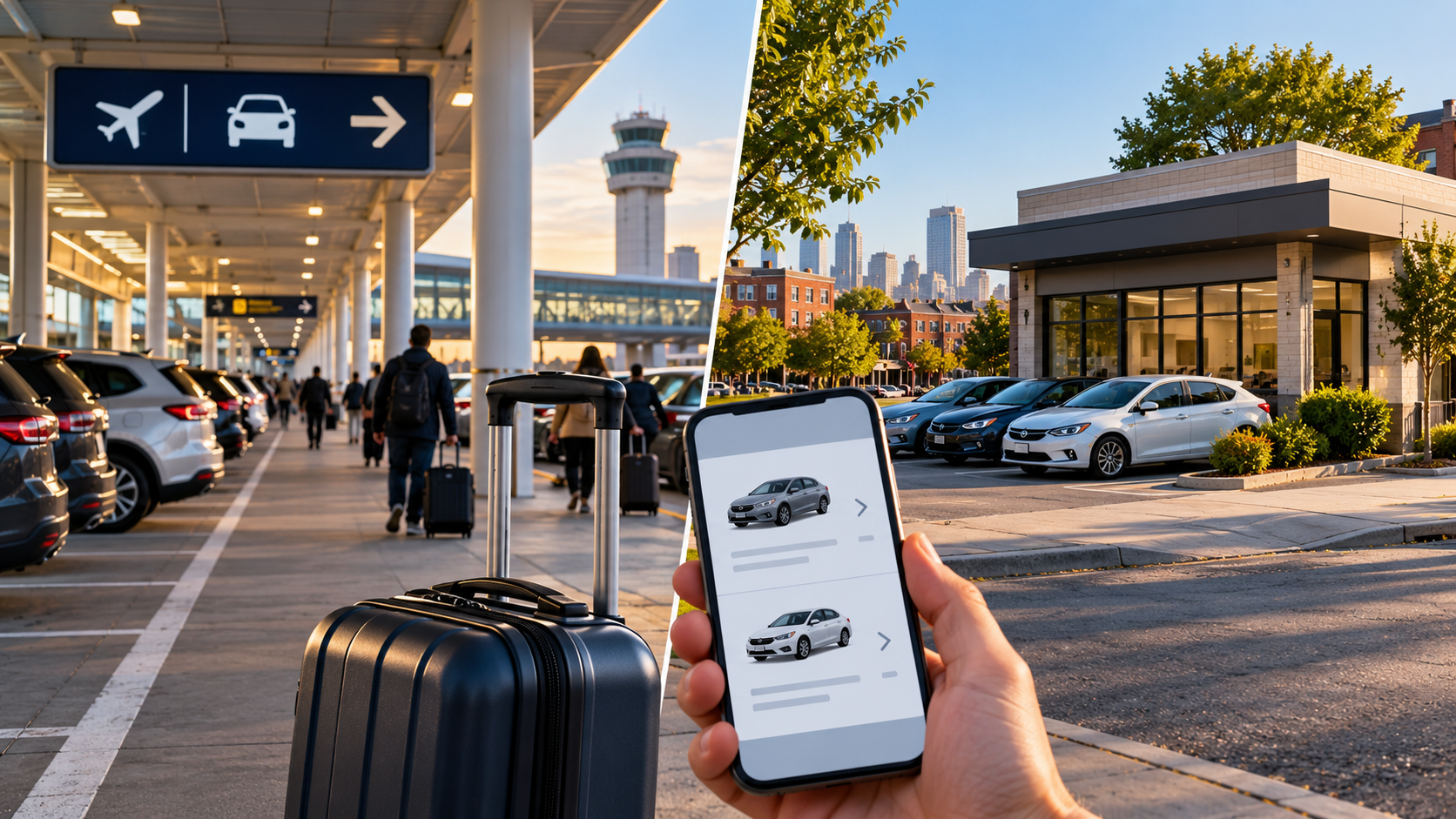
Editorial illustration comparing a busy airport car-rental pickup area with a neighborhood car-rental office.

An airport rental car can be expensive even when its advertised daily rate looks reasonable. Airport-related charges, local taxes and optional extras can raise the bill, while a neighborhood rental office may advertise a lower rate for the same car. But the trip from the airport to that office, its limited hours and the return trip can erase much of the apparent saving.

The way to choose is to compare complete rental quotes for the same vehicle class, dates and pickup and return times, then add the real cost of reaching each location. A neighborhood office is often worth considering when you can reach it cheaply or only need a car after spending a few days in the city. For a late arrival, an early departure or a short visit, the airport counter may be the better deal even at a higher rental price.

An $82 rental-price saving becomes $16

Consider two hypothetical quotes for the same three-day trip. Both offer a comparable compact car, unlimited mileage and the same pickup and return times; neither includes optional insurance or fuel purchases. The prices below are an illustration of the calculation, not live quotes from a rental company.

Three-day rental comparison Airport office Neighborhood office
Base rental charge $162 $126
Taxes and mandatory rental fees shown at checkout $78 $32
Total rental quote $240 $158
Transportation to pickup office $0 $30
Transportation after returning car $0 $36
Total to obtain and return the car $240 $224

The neighborhood rental’s checkout price is $82 lower, but getting to and from that location costs $66. The actual cash saving is only $16, before considering the extra travel time or the possibility of an after-hours problem. If those two transfers cost $10 more each than estimated, the neighborhood choice becomes $4 more expensive than the airport option.

This provides a useful break-even rule: the round-trip cost of reaching a neighborhood rental office must be less than the difference between the two complete rental quotes. Here, the transfer-cost ceiling is $82. A free ride from a friend or a convenient transit connection could make the off-airport rental attractive; an expensive rideshare in both directions might eliminate the savings.

Which airport charges are you avoiding?

Airport car-rental locations often have charges beyond the base rental rate. The Avis fee glossary describes concession-related fees, customer facility charges and location-specific surcharges. A customer facility charge may support airport rental facilities, while a concession-recovery charge generally reimburses a rental company for costs of operating at that location. Their names and amounts vary, so a fixed nationwide percentage would be misleading.

Moving to a nearby branch doesn’t guarantee that every airport-related charge disappears. The Federal Trade Commission’s rental-car guidance warns that airport surcharges can sometimes apply even when a rental company uses a shuttle to take customers to an off-site lot. Alamo also explains that some off-airport rentals carry airport-related fees. Compare the actual checkout summaries instead of assuming that a branch with a street address has no concession charges.

Also check whether you’re comparing the same kind of price. One screen may display the base rate while another shows a total including mandatory charges and taxes. The FTC’s 2025 fee-display rule for short-term lodging and event tickets should not be treated as a promise that every rental-car search result contains all fees. Get far enough into each booking process to see the total payable for the rental you intend to reserve.

Neighborhood branches have a different operating clock

The biggest hidden cost may arise from opening hours rather than a line item on the bill. A neighborhood branch that closes at 6 p.m. may be useless after a late flight, and an office closed on Sunday may not allow the airport-bound return you planned. By contrast, many airport rental counters accept after-hours returns, though you still need to follow the specific location’s procedures.

Enterprise’s published U.S. return guidance says non-airport branches generally require returns during normal business hours unless a location has an approved after-hours option. It also warns that a vehicle left after hours may not be checked in until the next business day and that the renter remains responsible until the satisfactory check-in. The company’s late-return policy illustrates why pickup and return times can affect billed days.

Do not assume you can book the cheaper neighborhood pickup and then return at the airport for free. Enterprise says even a return to a different location in the same city can carry a drop charge, mileage charge or higher rate. Price the exact pickup and drop-off offices together before using the hybrid plan.

Sometimes the cheapest rental starts a day later

If you’re visiting a city for several days before taking a road trip, check whether you need a car immediately after landing. Suppose an airport rental costs $60 per day after its recurring charges, but you spend the first two nights sightseeing where transit is convenient. Picking up the car when the road-trip portion begins could avoid roughly $120 in rental charges, plus two nights of hotel parking, before considering the cost of getting to the later pickup office.

That $120 is another hypothetical example, and rental rates don’t always scale neatly with the number of days. Some weekly discounts make a shorter rental unexpectedly expensive. Still, changing the pickup day can save more than relocating pickup across town, especially where the hotel charges to park. Our hotel fee guide explains why parking belongs in the actual cost of a stay.

The reverse situation also exists. If you arrive late, need a car immediately and must catch an early flight home, paying more for a rental at the airport may spare two rideshares, two transfers with luggage and the risk of a closed neighborhood office. The airport premium can buy something useful: access to the vehicle at the moment you need it.

Check the return plan before committing

Open two complete rental quotes with identical vehicle classes, pickup times, return times, mileage allowances and protection options. Record the totals including required taxes and fees, then add transportation costs for any off-airport branch. Check actual opening hours for your arrival and departure days, including weekends and holidays, and verify whether after-hours returns are permitted.

Finally, make sure the apparent saving survives your broader trip plan. Fuel policies, paid toll programs, extra drivers and parking can change the overall economics; the FTC’s rental-car checklist covers these common additions. A cash saving of $15 might not justify two extra transfers, while a $150 saving with direct transit and convenient branch hours could be worthwhile.

For travelers comparing cheap flights, this is the same kind of calculation we apply to the hidden costs of airfare: use the full price for the itinerary you will actually take. A cheaper neighborhood rental is a genuine bargain only after the airport-to-office journey, return logistics and rental duration have been accounted for.

Hotel Resort Fees in 2026: How to Find the Real Price Before You Book

A hotel room advertised at $199 a night used to have a nasty habit of becoming a $249 room by the time you reached checkout.

The culprit was often a resort fee, destination fee, amenity fee or similarly named mandatory charge that was not included in the headline rate.

That became harder for hotels and booking sites to do after a federal pricing rule took effect in May 2025. But resort fees themselves did not disappear.

If your goal is to find the cheapest hotel in 2026, you still need to understand what is included in the displayed price, what can legally appear later and which optional expenses can make an apparently cheap room expensive.

The Short Answer

Hotels can still charge resort fees in 2026.

What changed is how mandatory fees must be displayed. Under the Federal Trade Commission’s Rule on Unfair or Deceptive Fees, businesses offering short-term lodging generally must prominently display the total price including mandatory fees they know and can calculate in advance.

Government taxes and genuinely optional extras can still be added separately.

So the old “$199 room plus a surprise $45 mandatory resort fee” pricing model should generally appear to you as a $244 price before taxes rather than $199.

What Counts as a Resort Fee?

A resort fee is a mandatory charge added to a hotel stay, often supposedly covering a package of amenities.

Depending on the hotel, that package might include:

  • Wi-Fi
  • fitness-center access
  • pool access
  • local phone calls
  • bottled water
  • beach chairs or towels
  • fitness classes
  • shuttle service
  • food or beverage credits

The problem for travelers has never just been whether those amenities have value. It is that guests often cannot decline the fee even if they do not use them.

If you must pay it to stay at the hotel, it is part of the cost of the room.

What Changed in 2025?

The FTC’s fee rule took effect May 12, 2025 and applies to short-term lodging as well as live-event tickets.

The rule requires businesses displaying a price to show the total price upfront, including mandatory charges they know and can calculate in advance.

The FTC gives an especially clear example: if a resort charges $199 per night plus a mandatory $39-per-day resort fee, the mandatory fee must be included in the total price displayed to the consumer.

This applies not only to hotels themselves but also to businesses selling short-term lodging.

What Can Still Be Added Later?

The rule does not mean the first number you see is necessarily the exact amount that will hit your credit card.

Some charges can still be excluded from the initial total, particularly:

  • government taxes and fees;
  • optional services you choose to purchase;
  • charges that cannot reasonably be calculated until you make a choice.

For example, optional valet parking does not have to be built into the room price if you can simply choose not to park there.

A mandatory destination fee is different. If every guest has to pay it, changing the name from “resort fee” does not make it optional.

Resort Fees Have Not Been Banned

This is an important distinction.

The federal rule is primarily a price-transparency rule. It does not generally prohibit a hotel from charging a $40 resort fee.

It requires the mandatory fee to be reflected in the upfront total price rather than being used to make the room initially appear cheaper than it really is.

For travelers, that is an improvement because comparison shopping becomes easier.

But a hotel charging a large mandatory fee can still be expensive.

How to Compare Two Hotels Correctly

Suppose you are considering two hotels for a three-night stay.

Hotel A Hotel B
Displayed nightly price $225 $245
3-night lodging price $675 $735
Parking $50/night Free
Breakfast Not included Included

Hotel A initially looks $60 cheaper.

But if you have a car, its parking adds $150. If you would otherwise spend $40 a day on breakfast for two people, Hotel B may easily become the cheaper stay.

The mandatory resort fee should now be reflected in the displayed lodging price. Other trip costs still require your own calculation.

Watch for Parking

Parking is one of the biggest remaining hotel-cost traps because it can be both expensive and legitimately optional.

A city hotel charging $55 a night for parking may still advertise a lodging price that excludes parking if guests can arrive without a car.

For a four-night stay, that is another $220.

Before booking, check:

  • self-parking price;
  • valet price;
  • whether parking includes in-and-out privileges;
  • nearby public garages;
  • whether you actually need a rental car.

Also Check the Cancellation Policy

A hotel at $240 per night with free cancellation may be better value than one at $220 that is completely nonrefundable.

That $20 difference buys flexibility.

When comparing prices, make sure you are looking at the same:

  • room type;
  • number of guests;
  • cancellation terms;
  • payment timing;
  • included meals;
  • parking situation.

Otherwise the lower price may simply represent a worse product.

Direct Booking vs. Expedia or Booking.com

The new fee-display rules make OTA-versus-direct comparisons easier, but you should still check both.

An Expedia or Booking.com member price may be cheaper. A direct reservation may earn hotel points, elite-night credit or status benefits.

We break that calculation down in our guide to booking a hotel directly versus Expedia or Booking.com.

The important point here is to compare the same stay after mandatory fees rather than comparing two different headline prices.

Airbnb and Vacation Rentals Are Part of the Same Problem

Vacation rentals can have their own assortment of mandatory cleaning and service charges.

The FTC rule covers short-term lodging broadly, and its guidance specifically gives a mandatory vacation-rental cleaning fee as an example of a charge that belongs in the displayed total price.

That makes it easier to compare an Airbnb-style rental against a hotel, although taxes and optional charges can still complicate the final bill.

For a broader comparison, see our guide to whether Airbnb is actually cheaper than a hotel.

A 60-Second Hotel Price Check

Before booking, I would check five things:

  1. Total lodging price: Ignore the old habit of multiplying a tempting headline rate without checking the total.
  2. Taxes: These may still appear separately.
  3. Parking: Especially important in cities and resorts.
  4. Meals and credits: Free breakfast or a genuinely useful food credit can change the comparison.
  5. Cancellation: Make sure the cheaper rate has acceptable terms.

Then divide the realistic total cost by the number of nights.

That is the number worth comparing.

What If a Hotel Still Hides a Mandatory Fee?

If a U.S. hotel or booking business advertises a lodging price and then adds a mandatory fee that should have been included upfront, save screenshots showing what was displayed.

The FTC accepts consumer reports through ReportFraud.ftc.gov.

A pricing discrepancy may also be worth raising with the hotel or booking platform before completing the purchase.

Bottom Line

Resort fees still exist in 2026. What has changed is the ability to hide them behind a deceptively low advertised hotel rate.

Mandatory fees that can be calculated upfront generally belong in the prominently displayed total price. Taxes and genuinely optional extras can still increase what you ultimately spend.

That means hotel comparison shopping is easier than it used to be, but it is not automatic.

Compare the total lodging price, then add the costs that matter for your particular trip: parking, food, transportation and flexibility.

The cheapest hotel is the one with the lowest real cost—not the lowest number that first caught your eye.

Source: Federal Trade Commission, Rule on Unfair or Deceptive Fees FAQs. The rule took effect May 12, 2025. Pricing practices and legal requirements can change.

Which Airlines Have the Fewest Extra Fees in 2026? The Real Cost of a Cheap Fare

A $79 airfare is not necessarily cheaper than a $129 airfare.

The difference can disappear once you add a carry-on, choose a seat or check a suitcase. Airline pricing in 2026 makes comparing the headline fare increasingly unreliable because the cheapest fare class on one airline may include something another carrier charges separately for.

The useful question is not which airline advertises the cheapest ticket. It is which airline gives you the lowest total price for the trip you actually intend to take.

The Short Answer

No major U.S. airline is completely free of add-on charges, and there is no single airline with the fewest fees for every traveler.

Delta, American, JetBlue and Southwest are relatively straightforward if you travel with a normal carry-on because they include one with their lowest economy fares. United is the important exception among the large network airlines: on most domestic Basic Economy tickets, United includes a personal item but not a full-size carry-on.

Frontier can still be extremely cheap for a traveler carrying only a small personal item and accepting an assigned seat. Once you start adding an overhead bag, checked luggage and seat selection, however, the useful comparison is between Frontier’s completed price and the fare another airline already includes.

Airline Fee Comparison for a Typical U.S. Trip

Airline Personal Item Carry-On 1st Checked Bag Advance Seat Selection on Cheapest Fare
Delta Included Included Commonly $45 domestic Usually not included with Main Basic
American Included Included Basic Economy generally $50 online / $55 at airport on many U.S. itineraries Available for a fee on Basic Economy
United Included Not included on most domestic Basic Economy tickets; important route and status/card exceptions apply Varies by itinerary; use United’s calculator Generally costs extra on Basic Economy
JetBlue Included Included From $45 off-peak when purchased early Not included with Base fare
Southwest Included Included $45 on most lower fares for applicable U.S. mainland travel Basic gets a Standard seat assigned at check-in
Frontier Included Costs extra on Basic fare Costs extra on Basic fare Costs extra on Basic fare

Fees can vary by route, travel date, ticketing date, fare class, elite status and credit-card benefits. Use this table to understand the basic structure, then check the final price for your actual itinerary before booking.

Southwest Is No Longer the Automatic Winner for Checked Bags

For years, Southwest had an obvious advantage for anyone checking luggage: two checked bags were included. That is no longer the standard deal for most passengers.

For U.S. mainland travel booked, ticketed or changed on or after April 9, 2026, Southwest lists a $45 first checked bag and $55 second checked bag for Basic, Choice and Choice Preferred fares. Choice Extra includes two checked bags, while certain Rapid Rewards elite members and eligible credit-card holders receive additional bag benefits.

You can check the current charges on Southwest’s optional travel charges page.

Southwest still includes a carry-on and personal item. Its seating system has changed as well: assigned seating began for travel on January 27, 2026, and Basic passengers generally receive a Standard seat assignment at check-in rather than choosing a seat when booking.

That means Southwest can still be a good value, but you should no longer assume it wins automatically simply because you are checking luggage.

Delta: Carry-On Included, Checked Bag Extra

Delta remains relatively simple for a traveler who can fit everything into a carry-on. Delta permits one carry-on and one personal item, while its current common domestic fee for travelers without a qualifying exemption is $45 for the first standard checked bag and $55 for the second.

Delta publishes its current baggage charges here.

The larger limitation on Delta’s cheapest Main Basic fare is seating. A seat is generally assigned after check-in unless you pay for an eligible advance assignment, and Main Basic also comes with restrictions on flexibility, mileage earning and upgrades.

For a solo traveler with a carry-on who does not care where they sit, Main Basic can still be a clean low-cost option. Add checked luggage and paid seat selection, and the price difference from a more inclusive fare can shrink quickly.

American: Watch the Difference Between Main Cabin and Basic Economy

American includes one personal item and one full-size carry-on even on Basic Economy. The bigger cost difference appears when you check luggage.

For Basic Economy tickets issued on or after May 18, 2026 on many itineraries within the U.S. and nearby markets, American lists the first checked bag at $50 when paid online and $55 at the airport. Standard Main Cabin pricing can be lower.

American’s checked-bag page has the route- and ticket-date-specific details.

Basic Economy also does not include complimentary advance seat choice for most travelers. You can purchase a specific seat or accept the free seat assignment provided at check-in.

This is exactly the kind of fare where a $20 or $30 headline discount can vanish if you buy back the benefits you actually want.

United: Basic Economy Can Change the Carry-On Math

United deserves special attention because its Basic Economy carry-on rules differ from those of Delta and American.

On most domestic United Basic Economy tickets, you can bring a personal item that fits under the seat, but a normal full-size carry-on is not included. That can materially change a fare comparison if you travel with a roller bag.

There are important exceptions. Basic Economy passengers on transatlantic and transpacific itineraries and routes to South America receive a carry-on. MileagePlus Premier members, certain companions, Star Alliance Gold members and eligible United credit-card holders can also have different carry-on benefits.

Checked-bag pricing also varies by route, ticketing date and passenger status rather than fitting neatly into one national price. Use United’s checked-bag calculator with the actual itinerary before deciding which fare is cheaper.

United Basic Economy also generally restricts complimentary advance seat selection. If you want a carry-on, a specific seat and more flexibility, compare the cost of standard Economy rather than automatically buying Basic Economy and adding extras afterward.

JetBlue: Carry-On Included, But Base Is Still Stripped Down

JetBlue’s Base fare includes a carry-on bag, which makes the baggage comparison simpler than it is with domestic United Basic Economy. What Base does not include is advance seat selection.

JetBlue’s current fare structure lists a carry-on across Base, Standard and Flex options, while Standard and Flex include seat selection. JetBlue’s fare comparison explains the current differences.

Checked baggage still costs extra for most economy passengers. For many U.S., Latin America, Caribbean and Canada itineraries, JetBlue currently lists an off-peak first checked bag at $45 when added more than 24 hours before departure, with higher prices during peak periods and closer to departure.

JetBlue’s current fee schedule is worth checking before booking because timing and season can affect the price.

Frontier: Basic Is Cheap Because Very Little Is Included

Frontier’s Basic fare includes a personal item. A normal carry-on, checked suitcase and advance seat assignment cost extra.

That can be an excellent deal for someone taking a short trip with a backpack and accepting whichever seat is assigned. It can be much less attractive for a traveler who intends to purchase several extras.

Frontier’s Economy bundle includes a personal item, carry-on bag, standard seat selection and no change or cancellation fee. Premium adds premium seating and priority boarding, while Business includes two checked bags and its higher-tier seating benefits.

Frontier lists its current bundle benefits here.

Frontier uses variable baggage pricing, so there is no single carry-on or checked-bag price that works for every flight. The airline says bags are generally cheapest when purchased earlier, making the timing of the purchase part of the fare calculation.

Who Has the Fewest Fees Depends on What You Carry

If You Travel With Only a Personal Item

Frontier can be particularly competitive because its Basic fare already includes the one thing you need. If you can genuinely travel with only a small under-seat bag and do not care about seat assignment, there may be very little to add.

If You Travel With a Carry-On

Delta, American, JetBlue and Southwest are simpler because a normal carry-on is included with their lowest economy products. With United Basic Economy, check the itinerary carefully because the carry-on allowance depends on the route and any qualifying status or card benefits.

With Frontier, add the carry-on charge or compare the Economy bundle before deciding which fare is really cheaper.

If You Check a Bag

Do the round-trip math before booking. A $45 first checked-bag fee becomes another $90 on a round trip before you consider a second bag, overweight charges or other extras.

And do not rely on the old assumption that Southwest automatically includes checked bags for everyone. Its lower fare classes now charge for them on applicable U.S. mainland itineraries.

If You Need to Choose Your Seat

The cheapest fare class often becomes less attractive when a specific seat matters to you.

Instead of automatically buying a stripped-down fare and then adding a bag and seat separately, compare the next fare class or bundle. Sometimes the more inclusive fare costs less than purchasing each extra à la carte.

A $99 Fare Versus a $149 Fare

Suppose Airline A advertises a $99 one-way fare while Airline B charges $149.

Airline A Airline B
Base fare $99 $149
Carry-on $45 Included
Seat selection $25 Included
Real one-way cost $169 $149

The apparently more expensive fare is actually $20 cheaper for that traveler.

Change the traveler to someone carrying only a backpack who does not care about seat assignment, and Airline A goes back to costing $99. The same airfare can therefore be a bargain for one traveler and poor value for another.

How to Compare Cheap Flights Without Getting Fooled by the Headline Price

Before choosing between two fares, price the trip all the way through with the things you genuinely expect to use:

  • Personal item allowance
  • Carry-on bag
  • Checked luggage
  • Seat selection
  • Family seating needs
  • Change or cancellation flexibility
  • Airport transportation
  • Credit-card and elite-status benefits

Then compare the totals.

This is the same principle behind our guide to the hidden costs of cheap flights. The goal is not to avoid low-cost carriers. It is to stop comparing incomplete prices.

One Fee That Is Particularly Easy to Avoid

Overweight-bag charges are among the least productive ways to spend travel money.

Frontier, like other airlines, imposes additional charges when a checked bag exceeds its standard weight allowance. If you check luggage regularly, weighing the suitcase at home before leaving for the airport is a cheap precaution.

It also gives you time to redistribute heavy items instead of discovering the problem while standing at the ticket counter.

Compare the Trip You Are Actually Taking

The cheapest airline for a weekend traveler carrying a backpack may be the most expensive choice for a family checking several bags.

Instead of asking which airline has the fewest fees in the abstract, ask which airline gives you the lowest final price for the baggage, seating and flexibility you actually need.

Once you compare fares that way, some supposedly cheap flights stop looking cheap. Others turn out to be every bit as inexpensive as the headline price suggested.

Hidden Costs of Cheap Flights (And How to Avoid Them)

Cheap flight deals often look irresistible — until extra fees start appearing during checkout or after booking. Many travelers discover that a low advertised fare can quickly become far more expensive once baggage, seat selection, and airport logistics are included.

This guide breaks down the most common hidden costs of cheap flights and explains how travelers can avoid paying more than expected.

The Short Answer

Cheap flights are often cheapest only if you travel light, accept limited flexibility, and understand airline fee structures in advance. For many travelers, the lowest advertised fare is not the lowest total trip cost.

Common Hidden Costs of Cheap Flights

Baggage Fees

Many budget airlines charge separately for carry-on and checked bags. A fare that appears $80 cheaper can become more expensive once baggage fees are added.

  • Carry-on bag fees: $25–$75 each way
  • Checked bags: $30–$100 each way

Seat Selection Fees

Basic fares frequently assign seats randomly unless you pay extra. Families or travelers wanting guaranteed seating together often face additional charges.

Airport Choices

Low fares may use secondary airports located far from city centers, increasing transportation costs and travel time.

  • Airport transfers can add $20–$60 or more
  • Longer travel times reduce overall value

Change and Cancellation Fees

Budget tickets are often non-refundable or expensive to change, making unexpected schedule changes costly.

A Real Cost Example

Consider a $120 round-trip fare:

  • Carry-on bag: $60
  • Seat selection: $25
  • Airport transfer difference: $30

Total real cost: $235

In many cases, a slightly higher base fare on a traditional airline would have been cheaper overall.

How to Avoid Hidden Flight Costs

  • Compare total price, not ticket price
  • Check baggage rules before booking
  • Consider airport transportation costs
  • Avoid basic economy for longer trips
  • Factor flexibility into ticket value

When Cheap Flights Actually Make Sense

  • Short trips with minimal luggage
  • Flexible travel plans
  • Solo travelers
  • Direct flights with clear fee structures

Final Verdict

Cheap flights can provide excellent value, but only when travelers understand the full cost structure. Evaluating total trip expenses — not just the headline fare — is the best way to avoid unpleasant surprises.


Staying connected abroad is another hidden travel expense — see our review explaining whether Airalo is worth using.


Related Guides